

Building a Future-Ready Business: Key Strategies for Long-Term Digital Growth
Businesses today are operating in a rapidly changing environment. Customer expectations are increasing, competition is becoming stronger, and technology continues to reshape how companies operate.
Organizations that rely only on traditional processes often struggle to keep up with changing market demands. Manual workflows, disconnected systems, limited data visibility, and outdated infrastructure can slow down growth and reduce efficiency.
A future-ready business is not only focused on adopting new technology. It is focused on creating flexible systems, improving decision-making, strengthening operations, and preparing for future challenges.
Digital transformation has become an important part of this journey. By combining technologies such as cloud computing, artificial intelligence, automation, cybersecurity, and data analytics, businesses can create stronger foundations for sustainable growth.
Companies like DLAN Group help organizations build modern technology environments through IT consulting, cloud solutions, cybersecurity, telecom services, and digital transformation strategies. Similarly, it supports businesses by using artificial intelligence and data-driven solutions to improve efficiency and unlock new opportunities.
Whether a company operates in professional services, transportation, manufacturing, automotive, healthcare, or any other industry, becoming future-ready requires a clear technology strategy.
What Does It Mean to Be a Future-Ready Business?
A future-ready business is an organization that can adapt quickly to changes while maintaining operational efficiency.
It does not simply invest in technology because it is popular. Instead, it chooses solutions that support business goals, improve customer experiences, and create measurable value.
Future-ready companies usually have:
- Flexible digital infrastructure
- Connected business systems
- Data-driven decision-making processes
- Automated workflows
- Strong cybersecurity practices
- Scalable cloud environments
- Customer-focused digital experiences
- A culture of continuous improvement
These capabilities allow businesses to respond faster when customer needs change, new competitors enter the market, or unexpected challenges occur.
Why Digital Transformation Is Important for Business Growth
Digital transformation is no longer limited to large enterprises. Businesses of all sizes are using technology to improve productivity, reduce costs, and create better customer experiences.
Traditional business models often depend on disconnected tools and manual processes. Employees may spend significant time performing repetitive tasks, searching for information, or managing different systems.
Digital transformation helps companies create connected operations where information flows smoothly between departments.
For example:
- Sales teams can access updated customer information.
- Managers can monitor performance through real-time dashboards.
- Employees can automate repetitive administrative tasks.
- Customers can receive faster and more personalized services.
- Leaders can make decisions based on accurate data.
A strong digital transformation strategy helps businesses move from reactive operations to proactive growth.

Building a Strong Technology Foundation
Every future-ready business requires a reliable technology foundation.
Technology infrastructure includes the systems, applications, networks, and platforms that support daily operations.
A weak foundation can create problems such as:
- Slow business processes
- Security vulnerabilities
- Poor collaboration
- Limited scalability
- Higher operational costs
Modern businesses need technology environments that can grow with their requirements.
This includes:
Cloud-Based Infrastructure
Cloud technology allows businesses to access computing resources, applications, and storage without depending completely on physical infrastructure.
Cloud solutions provide benefits such as:
- Better scalability
- Remote accessibility
- Improved collaboration
- Faster deployment
- Reduced infrastructure limitations
Organizations can increase or decrease resources based on demand, making cloud technology suitable for growing businesses.
DLAN Group provides cloud-focused technology solutions that help businesses create secure and scalable digital environments.
Using Artificial Intelligence to Improve Business Operations
Artificial intelligence has become one of the most important technologies shaping the future of business.
AI allows companies to analyze information, automate processes, improve customer interactions, and make better decisions.
Businesses are using AI for:
- Customer support automation
- Data analysis
- Predictive insights
- Document processing
- Workflow automation
- Personalized recommendations
- Business intelligence
For example, AI-powered systems can analyze large amounts of business data and identify patterns that humans may miss.
Through DLAN.ai, businesses can explore AI-driven solutions that help improve productivity, automate processes, and transform how teams work with information.
AI does not replace business strategy. Instead, it helps companies make smarter decisions and operate more efficiently.
The Importance of Data-Driven Decision Making
Data has become one of the most valuable assets for modern organizations.
Every business generates information through:
- Customer interactions
- Sales activities
- Website visits
- Operational systems
- Financial records
- Employee processes
However, collecting data is not enough. Businesses need the ability to understand and use that information effectively.
Data analytics helps organizations:
- Identify customer trends
- Understand business performance
- Predict future opportunities
- Improve resource planning
- Reduce operational waste
- Make informed decisions
A future-ready company does not rely only on assumptions. It uses accurate information to guide strategic decisions.
Industries such as transportation and automotive are already benefiting from data-driven approaches.
For example, companies like GCS Transfer can use technology and analytics to improve customer experiences, optimize service operations, and understand travel patterns.
Similarly, automotive businesses such as APG OEM can benefit from better data management for inventory planning, supply chain visibility, and operational efficiency.
Improving Business Processes Through Automation
Manual processes can slow down growth.
Employees often spend valuable time completing repetitive tasks that could be automated.
Business automation helps organizations improve efficiency by reducing unnecessary manual work.
Common areas where automation can help include:
- Customer communication
- Reporting
- Data entry
- Workflow approvals
- Inventory management
- Scheduling
- Document processing
Automation allows employees to focus on higher-value activities such as strategy, creativity, and customer relationships.
A well-designed automation strategy does not remove the human element. Instead, it allows teams to work smarter.
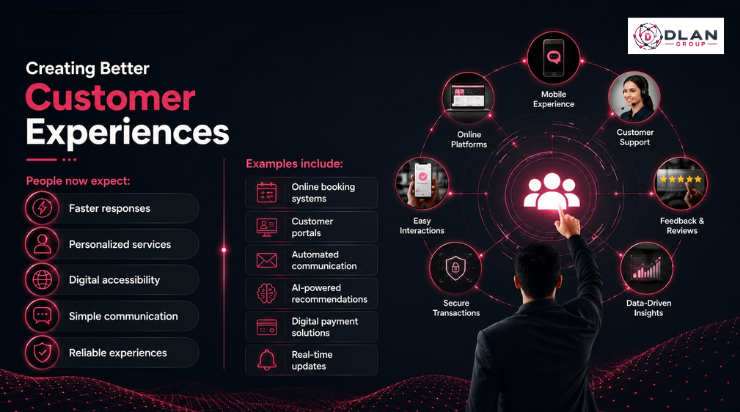
Creating Better Customer Experiences
Customer expectations have changed significantly.
People now expect:
- Faster responses
- Personalized services
- Digital accessibility
- Simple communication
- Reliable experiences
Businesses that fail to meet these expectations may lose customers to competitors.
Technology helps companies understand customer needs and create smoother experiences.
Examples include:
- Online booking systems
- Customer portals
- Automated communication
- AI-powered recommendations
- Digital payment solutions
- Real-time updates
The transportation industry is a strong example of this change. Modern customers expect convenient booking, reliable service, and transparent communication.
Companies such as GCS Transfer demonstrate how technology can support better customer experiences in service-based industries.
Strengthening Cybersecurity for Long-Term Growth
As businesses become more digital, cybersecurity becomes increasingly important.
More connected systems mean more opportunities but also more risks.
Businesses must protect:
- Customer information
- Financial data
- Employee records
- Business applications
- Digital infrastructure
A future-ready company integrates security into every technology decision.
Important cybersecurity practices include:
- Access control
- Data protection
- Employee awareness
- Regular monitoring
- Secure cloud configuration
- Risk management
DLAN Group helps organizations strengthen their cybersecurity approach by combining protection, governance, and technology expertise.
Security should not be considered an additional feature. It should be part of the business foundation.
Creating Connected Business Ecosystems
Modern businesses rarely operate using a single system.
They depend on multiple platforms, partners, suppliers, customers, and digital tools.
A connected ecosystem allows different systems to communicate effectively.
Benefits include:
- Better collaboration
- Faster information sharing
- Improved visibility
- Reduced duplication
- Better customer service
For example:
A transportation business may need connected booking, customer management, payment, and fleet systems.
An automotive business may require integration between inventory, suppliers, production planning, and customer management platforms.
Technology partners help organizations create these connected environments.
The Role of Technology Consulting in Business Growth
Many businesses understand the importance of technology but struggle with choosing the right solutions.
Technology consulting helps companies:
- Understand their current challenges
- Identify improvement opportunities
- Select suitable technologies
- Plan implementation
- Reduce unnecessary costs
- Improve long-term scalability
Instead of adopting technology randomly, businesses can create a structured roadmap.
DLAN Group works with organizations to design technology strategies aligned with business objectives.
A successful technology investment should solve real business problems and create measurable improvement.
Preparing Employees for a Digital Future
Technology alone cannot transform a business.
Employees also need the skills and mindset required to use new systems effectively.
Companies should invest in:
- Digital training
- Technology awareness
- Process improvement culture
- Continuous learning
When employees understand new tools, adoption becomes easier and businesses gain more value from their investments.
A future-ready organization combines technology with human capability.
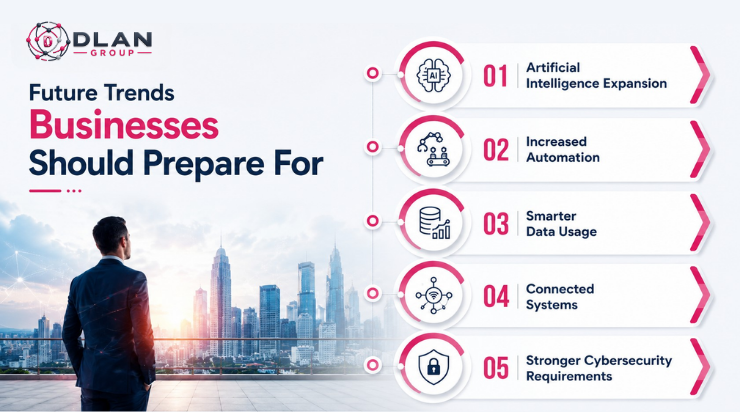
Future Trends Businesses Should Prepare For
The next generation of businesses will continue to be shaped by emerging technologies.
Important trends include:
Artificial Intelligence Expansion
AI will become more integrated into everyday business operations.
Increased Automation
More companies will automate repetitive workflows to improve productivity.
Smarter Data Usage
Organizations will rely more on analytics and real-time insights.
Connected Systems
Businesses will continue moving toward integrated digital ecosystems.
Stronger Cybersecurity Requirements
Security will become a critical part of every digital strategy.
Companies that prepare early will have stronger opportunities for future growth.
Frequently Asked Questions
What makes a business future-ready?
A future-ready business has flexible technology systems, strong cybersecurity, efficient processes, data-driven decision-making, and the ability to adapt quickly to change.
Why is digital transformation important for companies?
Digital transformation helps businesses improve efficiency, reduce costs, enhance customer experiences, and create better opportunities for growth.
How can AI help businesses?
AI can automate processes, analyze data, improve customer support, provide insights, and help companies make smarter decisions.
Is digital transformation only for large companies?
No. Businesses of all sizes can benefit from digital transformation by adopting solutions according to their needs and goals.
How does cybersecurity support business growth?
Cybersecurity protects important information, reduces risks, builds customer trust, and helps businesses operate safely in a digital environment.
Conclusion: Build a Business Ready for Tomorrow
The future belongs to businesses that can adapt, innovate, and use technology strategically.
Becoming future-ready is not about adopting every new technology. It is about creating a strong foundation that supports growth, efficiency, security, and customer satisfaction.
From AI-powered solutions and cloud infrastructure to cybersecurity and connected business systems, modern technology provides opportunities for organizations across every industry.
DLAN Group helps businesses transform their operations through advanced technology solutions, while DLAN.ai enables organizations to explore the power of AI and automation.
Whether you are improving customer experiences like service-based businesses, optimizing operations like automotive companies, or building scalable enterprise systems, the right technology strategy can help you achieve long-term success.
Contact DLAN Group today to explore how digital solutions can help your business become future-ready.


Leave a Reply
Want to join the discussion?Feel free to contribute!