
How Vendor Consolidation Can Reduce Cost, Risk, and Operational Complexity
As businesses grow, they usually add more service providers.
One company manages the website. Another provides cybersecurity. A separate provider handles cloud infrastructure. Additional vendors may supply hardware, telecom, transportation, automotive products, software, and technical support.
Each provider may solve an immediate problem, but the number of vendors can become difficult to control.
Invoices increase. Contracts renew at different times. Responsibilities overlap. Security standards become inconsistent. Employees do not always know which provider to contact.
Vendor consolidation can help businesses reduce this complexity by working with fewer, more capable, and better-connected service partners.
Organizations working with DLAN Group can access a connected ecosystem covering digital technology, security, infrastructure, regional support, automotive solutions, and professional mobility.
What Is Vendor Consolidation?
Vendor consolidation is the process of reducing the number of external providers used by a business and moving related services to a smaller group of trusted partners.
It does not mean placing every business function with one company.
Instead, it means identifying where multiple providers are delivering similar, connected, or overlapping services and determining whether those relationships can be simplified.
For example, a company may have separate providers for:
- IT consulting
- Cloud infrastructure
- Cybersecurity
- Telecom
- Software support
- Data management
- Hardware
- Digital platforms
- Transportation
- Automotive requirements
Some separation may be necessary. However, excessive fragmentation can create unnecessary cost and management pressure.

How Vendor Sprawl Develops
Vendor sprawl usually happens gradually.
A department needs a new tool, so it selects a provider. Another team needs technical support and hires someone else. A new location chooses a local supplier. A temporary solution becomes permanent.
Over time, the company may have dozens of vendors without a complete record of:
- What each vendor provides
- Who owns the relationship
- How much each contract costs
- Which data the vendor can access
- When contracts renew
- Whether services overlap
- How performance is measured
- What happens if the provider becomes unavailable
Vendor sprawl is one of the operational issues that may remain unnoticed until it begins affecting cost, security, or service quality.
It often develops alongside other hidden business challenges that slow company growth.
The Hidden Cost of Too Many Vendors
The direct service fee is only one part of vendor cost.
Every provider also requires internal management.
Employees may need to:
- Attend separate meetings
- Process different invoices
- Review multiple contracts
- Manage separate user accounts
- Coordinate between providers
- Track different support requests
- Explain the same problem several times
- Monitor different service standards
- Manage multiple renewal dates
These activities consume time that may not appear clearly in the vendor budget.
Fragmentation can also create technical costs. Two systems may perform similar functions, platforms may not integrate, and different providers may recommend conflicting solutions.
Vendor consolidation helps businesses look at the total operational cost rather than only comparing individual prices.
Improve Accountability
When several providers support the same process, responsibility can become unclear.
A cloud application may stop working, but the software provider blames the network. The network provider blames the cloud platform. The cloud provider says the problem is related to user access.
The customer is left coordinating the investigation.
A more consolidated vendor structure can improve accountability by creating clearer ownership.
The business should know:
- Who leads each service area
- Who handles incidents
- Which provider coordinates related suppliers
- How issues are escalated
- What response time is expected
- How performance is reported
Clear accountability reduces delays and prevents problems from being passed between providers.
This coordinated approach reflects the broader idea of connected services built around operational performance.
Strengthen Cybersecurity and Data Control
Every vendor with access to business systems creates another potential security consideration.
External providers may access:
- Customer records
- Employee information
- Cloud platforms
- Administrator accounts
- Business applications
- Network systems
- Communication tools
- Financial information
- Devices and hardware
When vendor relationships are not managed properly, inactive accounts, excessive permissions, inconsistent security controls, and undocumented access may remain in place.
Vendor consolidation can make security easier to manage because the organization has fewer access relationships to review.
However, consolidation does not remove the need for due diligence.
Businesses should still review:
- Security policies
- Data-handling practices
- Access controls
- Incident response procedures
- Backup arrangements
- Compliance requirements
- Subcontractors
- Service continuity
- Contract termination procedures
Cybersecurity should remain a central part of every vendor decision.
Create Better Integration Between Services
Many business services depend on each other.
Cloud systems depend on networks and user access. Cybersecurity depends on visibility across devices and platforms. Telecom systems may connect with customer service software. Hardware must support applications. Data analytics requires reliable information from several systems.
When providers work independently, these connections may be ignored.
An integrated service structure can improve:
- System compatibility
- Data movement
- Communication
- Technical planning
- Incident response
- Reporting
- User support
- Long-term scalability
As the future of business services continues to develop, organizations increasingly need providers that understand how technology, security, communication, mobility, and customer service affect one another.
The value does not come simply from reducing the number of vendors. It comes from improving how the remaining providers work together.
Standardize Service Quality
Different vendors may follow different support processes, security practices, response times, and reporting methods.
This can create an inconsistent experience across departments and locations.
Vendor consolidation gives businesses an opportunity to establish common standards for:
- Response times
- Service availability
- Reporting
- Documentation
- Data protection
- Communication
- Escalation
- Performance reviews
- Customer support
- Business continuity
Standardization is particularly valuable for businesses operating across multiple regions.
A company can maintain common expectations while still using regional teams where local support is required.
Improve the Customer Experience
Customers may never know how many vendors a company uses, but they experience the results of those relationships.
Poor vendor coordination can cause:
- Slow responses
- System downtime
- Repeated requests for information
- Inconsistent communication
- Delayed deliveries
- Unavailable services
- Security concerns
- Confusing support processes
Better vendor coordination helps internal teams serve customers more effectively.
When technology, communication, security, infrastructure, and service providers work together, employees can respond more quickly and consistently. This relationship is examined further in DLAN’s article on how strategic business services shape customer experience.
Consolidate Services Around Business Priorities
Vendor consolidation should not begin with the goal of reaching the lowest possible supplier count.
It should begin by identifying the capabilities the organization needs to grow and operate effectively.
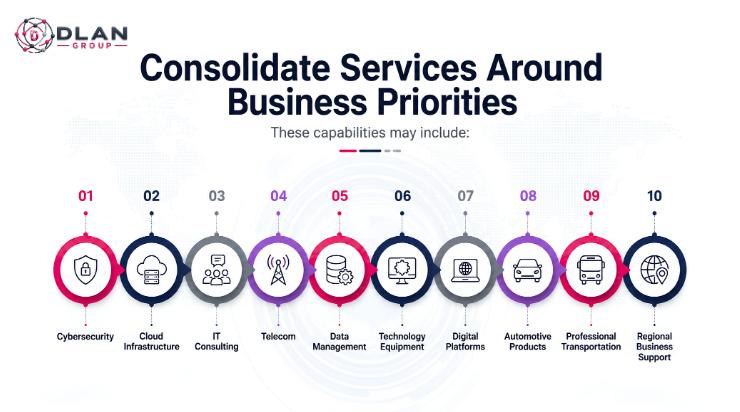
These capabilities may include:
- Cybersecurity
- Cloud infrastructure
- IT consulting
- Telecom
- Data management
- Technology equipment
- Digital platforms
- Automotive products
- Professional transportation
- Regional business support
Reviewing the seven business services every growing company should consider can help leaders identify which services are strategically important and which vendor relationships may be duplicated.
The objective is to simplify management without reducing service quality or specialist capability.
Use a Connected Business Ecosystem
A connected ecosystem can support vendor consolidation without forcing every requirement into one general service.
The DLAN Group portfolio brings together DLAN AI, CyberHelm AI, GTSS Hub US, GTSS Hub Global, Minnesota Computers, APG OEM, GCS Transfer, DLAN Pakistan, and DLAN US.
Together, these businesses cover areas such as intelligent digital solutions, automation, cybersecurity, technology infrastructure, regional business services, automotive products, and professional transportation.
Clients can access specialized capabilities while benefiting from a broader group structure.
This reduces the need to begin a completely separate provider search whenever a related operational requirement appears.
It also supports the kind of comprehensive business assistance described in Beyond Support: The Services That Keep Ambitious Businesses Running Smoothly.
Vendor Consolidation Does Not Mean Eliminating Every Specialist
Not every vendor relationship should be removed.
Some services require highly specialized expertise, local licensing, unique products, or independent oversight.
Businesses should avoid consolidating purely to reach a lower vendor count.
A vendor should remain separate when:
- Independent review is required
- The service involves specialized regulation
- The vendor offers unique expertise
- Concentration would create excessive risk
- The provider consistently delivers strong value
- A backup supplier is operationally necessary
- Local support is essential
The objective is to remove unnecessary complexity, not useful specialization.
A balanced vendor strategy combines consolidation with appropriate supplier diversity.
How to Build a Vendor Consolidation Strategy
1. Create a Complete Vendor Inventory
List every provider, service, contract owner, cost, renewal date, system access level, and business dependency.
Include vendors selected by individual departments, not only those managed by procurement or IT.
2. Group Related Services
Organize providers into categories such as:
- Technology
- Cybersecurity
- Cloud
- Telecom
- Hardware
- Software
- Transportation
- Automotive
- Marketing
- Professional services
This makes duplication easier to identify.
3. Identify Overlap
Look for multiple providers delivering similar services.
Examples may include several cloud platforms, duplicate communication tools, multiple cybersecurity products, or separate support providers for closely connected systems.
4. Assess Performance and Risk
Review service quality, cost, security, responsiveness, expertise, and business importance.
The lowest-priced provider may not always offer the lowest total cost.
5. Select Strategic Partners
Choose providers that can support current needs while adapting to future growth.
A strategic provider should understand the business, communicate clearly, maintain documentation, and coordinate effectively with other partners.
6. Plan the Transition
Vendor changes should be carefully managed.
The transition plan should cover:
- Data transfer
- Account removal
- Contract termination
- System migration
- Employee communication
- Service continuity
- Security access
- Documentation
- Backup arrangements
Avoid ending one service before the replacement has been tested.
7. Review the New Structure
After consolidation, measure whether the change has improved:
- Cost control
- Response time
- Accountability
- Security
- User experience
- Reporting
- Service availability
- Operational efficiency
Vendor consolidation should create measurable improvement rather than simply reducing the number of supplier names.
Questions to Ask a Potential Strategic Provider
Before consolidating services with a provider, ask:
- Which services can you manage directly?
- Which services involve subcontractors?
- How do you protect customer and business data?
- What support and escalation processes are available?
- Can your services scale across multiple locations?
- How do you measure performance?
- What happens during an outage or security incident?
- Can you integrate with existing platforms?
- How will the transition be managed?
- What ongoing support is included?
The provider’s responses should be clear, documented, and aligned with the company’s operational requirements.
Conclusion
Vendor consolidation can help growing companies reduce unnecessary cost, improve accountability, strengthen security, standardize service quality, and simplify operational management.
The goal is not to depend blindly on one provider. It is to create a controlled network of strategic partners that can support related business needs without adding unnecessary complexity.
A successful consolidation strategy begins with understanding the current vendor environment, identifying overlap, assessing performance, and selecting providers based on long-term business value.
Companies that simplify their vendor structure can spend less time coordinating suppliers and more time improving operations, customer service, innovation, and growth.
You can explore the group’s expertise, service approach, and commitment to secure and scalable solutions through the About DLAN Group page.
Simplify Your Business Operations With DLAN Group
Managing disconnected technology, cybersecurity, infrastructure, communication, automotive, transportation, and regional service providers can consume valuable time and create avoidable risks.
DLAN Group offers access to a connected ecosystem of specialist businesses designed to support different parts of modern operations. Its team can help you evaluate your current vendor structure, identify overlapping services, uncover operational gaps, and develop a more coordinated support model.
Whether you need to simplify technology management, strengthen cybersecurity, improve infrastructure, support business mobility, or access regional expertise, DLAN Group can help connect the right capabilities around your objectives.
Contact DLAN Group today to request a consultation, discuss your current vendor challenges, and discover how a more connected service ecosystem can reduce complexity and support long-term growth.
Frequently Asked Questions
What is vendor consolidation?
Vendor consolidation is the process of reducing the number of providers used by a company and moving related services to fewer strategic partners.
What are the main benefits of vendor consolidation?
The main benefits include lower management costs, clearer accountability, stronger security, easier reporting, improved integration, and more consistent service quality.
Is it risky to use fewer vendors?
It can create concentration risk if consolidation is poorly planned. Businesses should maintain appropriate backup arrangements and avoid placing every critical operation with one provider without proper safeguards.
How can vendor consolidation improve cybersecurity?
It reduces the number of external access relationships, platforms, accounts, and security processes that the business must monitor.
Which vendors should be consolidated first?
Businesses should first review vendors offering duplicate services, underused tools, overlapping platforms, or services closely connected to the same operational process.
How often should vendor relationships be reviewed?
Vendor relationships should generally be reviewed annually and before contract renewals, major technology changes, regional expansion, or business restructuring.


Leave a Reply
Want to join the discussion?Feel free to contribute!