
Cybersecurity Risk Assessment: A Practical Guide for Growing Businesses
Cybersecurity is no longer only an IT department concern. A security incident can affect customers, employees, finances, business operations, legal obligations, supplier relationships, and company reputation.
Growing businesses often add employees, applications, cloud services, devices, suppliers, customer data, and remote-access tools quickly. Every addition can introduce new security risks if it is not properly assessed and managed.
A cybersecurity risk assessment helps an organization understand what needs protection, which threats are most relevant, where weaknesses exist, and which improvements should be prioritized.
It gives management a structured way to make security decisions instead of reacting to individual threats without understanding the wider business impact.
Organizations can work with DLAN Group to assess technology risks and develop a more secure, scalable, and resilient digital environment.
What Is a Cybersecurity Risk Assessment?
A cybersecurity risk assessment is a structured process used to identify, analyze, and prioritize risks affecting an organization’s systems, data, networks, users, applications, and digital operations.
It examines four main areas:
- What technology and information does the business depend on?
- Which threats could affect those assets?
- Which vulnerabilities could allow those threats to succeed?
- What would the business impact be?
The result should be a prioritized action plan showing which risks require immediate attention, which can be addressed over time, and which may be accepted or transferred.
Why Cybersecurity Risk Assessments Matter
Without a risk assessment, businesses may spend money on security tools without addressing their most serious weaknesses.
For example, an organization may invest in advanced network protection while:
- Former employees still have active accounts
- Sensitive files are shared publicly
- Backups have never been tested
- Administrators do not use multifactor authentication
- Employees use weak passwords
- Third-party vendors have excessive access
- Cloud systems are configured incorrectly
- Critical applications are no longer supported
A risk assessment helps connect cybersecurity investment to actual operational priorities.
Cybersecurity is also one of the core elements of a future-ready business strategy.
Who Needs a Cybersecurity Risk Assessment?
Every organization using digital technology can benefit from an assessment, but it becomes especially important when a business:
- Stores customer or employee data
- Processes financial information
- Uses cloud applications
- Supports remote employees
- Depends on online services
- Works with external vendors
- Is expanding rapidly
- Has experienced a security incident
- Must meet regulatory or contractual requirements
- Uses outdated systems
- Has not reviewed security controls recently
- Does not clearly understand its digital assets
Smaller businesses should not assume they are too small to face cybersecurity threats. Limited internal resources, weak security processes, and dependence on a few systems may increase their operational exposure.
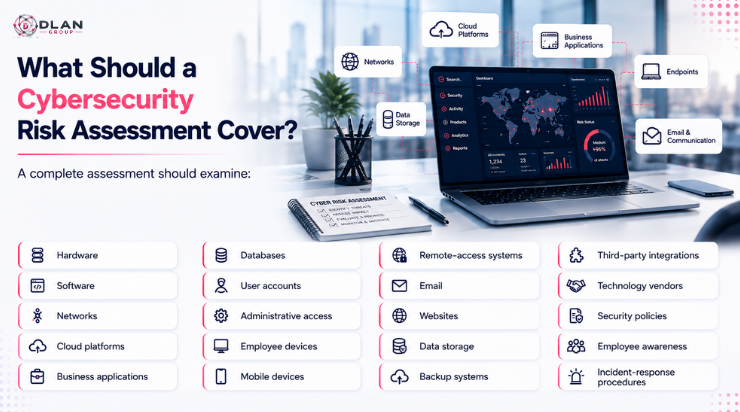
What Should a Cybersecurity Risk Assessment Cover?
A complete assessment should examine:
- Hardware
- Software
- Networks
- Cloud platforms
- Business applications
- Databases
- User accounts
- Administrative access
- Employee devices
- Mobile devices
- Remote-access systems
- Websites
- Data storage
- Backup systems
- Third-party integrations
- Technology vendors
- Security policies
- Employee awareness
- Incident-response procedures
It should consider both technical weaknesses and business-process weaknesses.
Step-by-Step Cybersecurity Risk Assessment Process
1. Define the Scope
Begin by deciding which parts of the organization will be assessed.
The assessment may cover:
- The complete organization
- One office
- A specific department
- A cloud environment
- A customer-facing application
- Remote working
- A new business acquisition
- A critical system
- A supplier relationship
The scope should be clear enough to manage while still covering the assets and processes that matter.
For a first assessment, growing businesses should usually prioritize systems supporting customer service, finance, operations, communication, employee access, and sensitive data.
2. Identify Business-Critical Assets
Create an inventory of the systems, information, and resources the business needs to operate.
These may include:
- Customer databases
- Financial records
- Employee information
- Email accounts
- Cloud platforms
- Websites
- Business applications
- Intellectual property
- Contracts
- Payment systems
- Network equipment
- Employee devices
- Backup systems
- Telecom services
- Administrative accounts
Each asset should have a defined owner responsible for understanding its business use and protection requirements.
A broad operational review may also reveal hidden challenges slowing business growth.
3. Classify Information
Not all information requires the same level of protection.
Businesses can classify data into categories such as:
Public Information
Information approved for public access, including published marketing content and public announcements.
Internal Information
Information intended for employees and approved business partners.
Confidential Information
Sensitive operational, commercial, customer, employee, or financial information requiring controlled access.
Restricted Information
Highly sensitive data that could cause serious legal, financial, operational, or reputational damage if exposed.
Classification helps determine appropriate access controls, encryption, storage, sharing, retention, and deletion requirements.
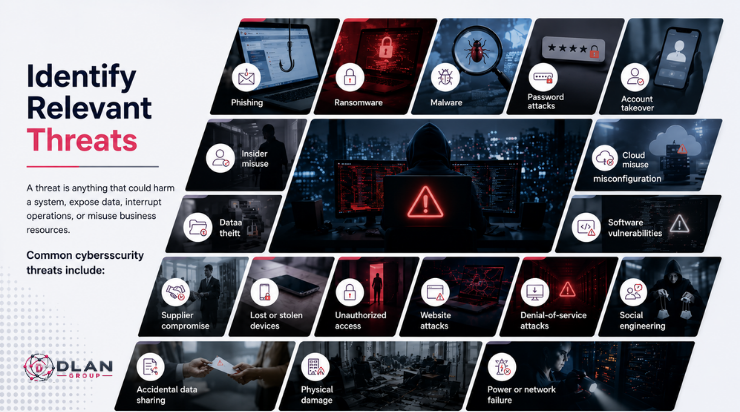
4. Identify Relevant Threats
A threat is anything that could harm a system, expose data, interrupt operations, or misuse business resources.
Common cybersecurity threats include:
- Phishing
- Ransomware
- Malware
- Password attacks
- Account takeover
- Insider misuse
- Data theft
- Cloud misconfiguration
- Software vulnerabilities
- Supplier compromise
- Lost or stolen devices
- Unauthorized access
- Website attacks
- Denial-of-service attacks
- Social engineering
- Accidental data sharing
- Physical damage
- Power or network failure
The assessment should focus on threats relevant to the organization’s technology, sector, locations, users, and business model.
5. Identify Vulnerabilities
A vulnerability is a weakness that may allow a threat to cause harm.
Examples include:
- Weak passwords
- Missing software updates
- Unsupported systems
- Excessive user access
- Shared administrator accounts
- Unencrypted devices
- Unprotected backups
- Insecure cloud settings
- Poor employee awareness
- Missing security policies
- Inadequate logging
- No incident-response plan
- Uncontrolled third-party access
- Weak network segmentation
- Unused accounts remaining active
Vulnerabilities can be discovered through:
- System reviews
- Configuration assessments
- Vulnerability scanning
- Access reviews
- Employee interviews
- Policy reviews
- Penetration testing
- Backup testing
- Cloud assessments
- Supplier evaluations
6. Assess Existing Security Controls
Document the protections already in place.
These may include:
- Firewalls
- Endpoint protection
- Multifactor authentication
- Email filtering
- Data encryption
- Network monitoring
- Access-control policies
- Security awareness training
- Backup systems
- Incident-response plans
- Vulnerability management
- Cloud security tools
- Physical security
- Supplier agreements
The purpose is to determine whether existing controls reduce risk sufficiently.
A control should not be considered effective simply because it has been purchased. Its configuration, coverage, monitoring, maintenance, and use should also be reviewed.
7. Evaluate Likelihood
Likelihood estimates how probable it is that a threat will exploit a vulnerability.
Factors affecting likelihood may include:
- Ease of exploitation
- Exposure to the internet
- Previous incidents
- Employee behavior
- Availability of attack tools
- Security-control strength
- Number of users
- System age
- Supplier access
- Sensitivity of the data
- Value to attackers
Organizations can use simple categories such as:
- Low
- Medium
- High
- Critical
The scoring method should be consistent across all assessed risks.
8. Evaluate Business Impact
Impact measures what may happen if a security incident occurs.
Potential consequences include:
- Operational downtime
- Financial loss
- Data exposure
- Customer disruption
- Legal costs
- Contractual penalties
- Regulatory action
- Reputation damage
- Lost productivity
- Recovery expenses
- Intellectual-property theft
- Supplier disruption
- Safety concerns
Business managers should participate in impact assessment because technical teams may not fully understand the commercial consequences of system failure.
A customer-facing application may appear technically simple but still be critical if it supports most of the company’s revenue.
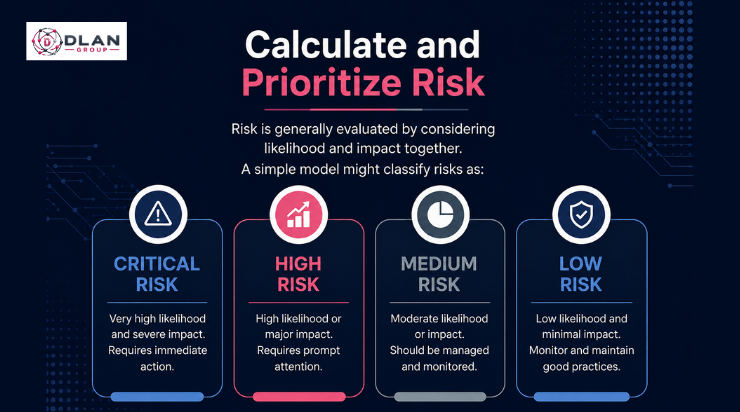
9. Calculate and Prioritize Risk
Risk is generally evaluated by considering likelihood and impact together.
A simple model might classify risks as:
Critical Risk
Immediate action is required because the issue could create severe business harm and has a significant chance of occurring.
High Risk
The issue requires priority action and senior-management oversight.
Medium Risk
The issue should be addressed within a defined timeframe.
Low Risk
The issue can be monitored or accepted when the cost of further treatment is not justified.
The organization should focus first on risks affecting critical systems, sensitive data, administrative access, backups, and operational continuity.
10. Select Risk Treatment Options
Businesses can respond to cybersecurity risks in four main ways.
Reduce the Risk
Introduce controls that reduce the likelihood or impact.
Examples include:
- Enabling multifactor authentication
- Updating software
- Removing unnecessary access
- Encrypting information
- Training employees
- Improving backups
- Monitoring systems
- Segmenting networks
Avoid the Risk
Stop the activity creating the risk.
For example, the company may retire an unsupported application rather than continue operating it.
Transfer the Risk
Transfer some financial or operational responsibility through insurance, contracts, or specialist providers.
The underlying risk may still exist, so transfer should not replace basic security controls.
Accept the Risk
Management may formally accept a low-level risk when further controls would be impractical or disproportionately expensive.
Risk acceptance should be documented and reviewed regularly.
Important Areas to Review
User Access and Identity
User accounts are common entry points for security incidents.
Review:
- Multifactor authentication
- Password requirements
- Administrative privileges
- Former employee accounts
- Shared accounts
- Guest access
- Remote access
- Access-review frequency
Employees should receive only the permissions required for their responsibilities.
Email Security
Email is frequently used for phishing, impersonation, malicious attachments, and fraudulent payment requests.
Review:
- Spam and phishing filters
- Email authentication
- Multifactor authentication
- Employee reporting processes
- Executive impersonation protection
- Attachment controls
- Security awareness training
Cloud Security
Cloud services can be secure, but incorrect configurations and excessive access can expose business information.
Review:
- Administrator access
- Public sharing
- Data encryption
- Logging
- Backup settings
- Third-party integrations
- User permissions
- Security alerts
- Inactive accounts
Cloud security should be included in any wider plan for business digital innovation.
Endpoint Security
Every laptop, desktop, tablet, and mobile device may create a potential entry point.
Review:
- Security software
- Disk encryption
- Updates
- Screen locking
- Device inventory
- Remote wiping
- Local administrator rights
- Personal-device policies
Backup and Recovery
Backups protect operations only when they are complete, secure, and recoverable.
Review:
- Backup frequency
- Backup coverage
- Storage location
- Encryption
- Access controls
- Offline or isolated copies
- Restoration testing
- Recovery time
- Monitoring and alerts
A business should not discover during a ransomware incident that its backups are incomplete or inaccessible.
Third-Party Vendors
Suppliers may have access to systems, applications, networks, or sensitive data.
Review:
- Vendor access
- Security obligations
- Data-handling practices
- Incident-notification requirements
- Subcontractors
- Account ownership
- Contract termination
- Access removal
- Business-continuity arrangements
Working with too many disconnected vendors may create security gaps and unclear responsibility. A vendor consolidation strategy can improve visibility and accountability.
Employee Awareness
Employees make daily decisions affecting cybersecurity.
They should understand how to:
- Recognize phishing
- Protect passwords
- Report suspicious activity
- Handle sensitive data
- Use approved applications
- Secure remote work
- Avoid unauthorized file sharing
- Respond to lost devices
Training should be practical, role-specific, and repeated regularly.
How Often Should a Cybersecurity Risk Assessment Be Conducted?
A full assessment should generally be performed regularly and whenever significant changes occur.
Triggers may include:
- New cloud platforms
- New business applications
- Company expansion
- Mergers or acquisitions
- New regulatory requirements
- Major supplier changes
- Remote-work expansion
- Security incidents
- Significant employee growth
- New customer requirements
- Office relocation
- Infrastructure modernization
Risk assessment should be treated as an ongoing business process rather than a one-time project.
The move toward connected business services also means that security reviews must consider relationships between systems, providers, people, and business processes.
Common Cybersecurity Assessment Mistakes
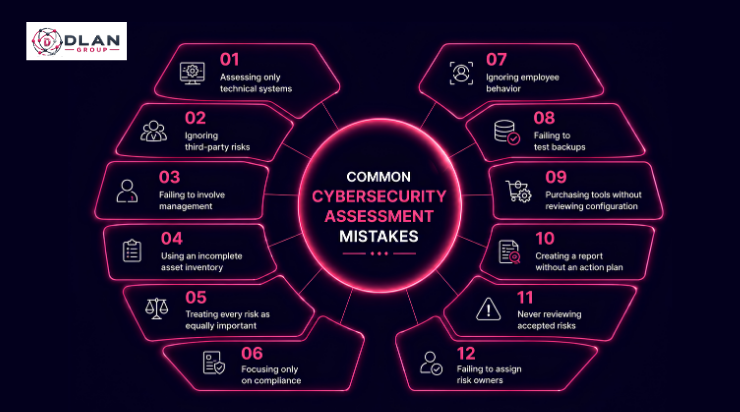
Businesses should avoid:
- Assessing only technical systems
- Ignoring third-party risks
- Failing to involve management
- Using an incomplete asset inventory
- Treating every risk as equally important
- Focusing only on compliance
- Ignoring employee behavior
- Failing to test backups
- Purchasing tools without reviewing configuration
- Creating a report without an action plan
- Never reviewing accepted risks
- Failing to assign risk owners
An assessment is valuable only when its findings lead to prioritized and measurable improvements.
Creating a Cybersecurity Improvement Plan
The final plan should include:
- Identified risk
- Affected asset
- Business impact
- Current controls
- Required improvement
- Responsible owner
- Budget
- Completion deadline
- Priority level
- Progress status
- Review date
Quick improvements may include:
- Enabling multifactor authentication
- Removing unused accounts
- Updating unsupported software
- Restricting administrator access
- Encrypting devices
- Testing backups
- Training employees
- Reviewing cloud-sharing settings
- Documenting incident contacts
- Updating vendor access
Longer-term improvements may involve:
- Replacing legacy systems
- Redesigning networks
- Implementing centralized identity management
- Introducing continuous monitoring
- Developing an incident-response program
- Consolidating vendors
- Modernizing backup infrastructure
- Hiring or outsourcing specialist expertise
Cybersecurity should be considered alongside other essential services supporting business growth.
Should the Assessment Be Internal or External?
An internal assessment may be suitable when the organization has experienced cybersecurity professionals, documented processes, and suitable assessment tools.
An external assessment may provide:
- Independent evaluation
- Specialist expertise
- Broader industry experience
- Technical testing
- Objective prioritization
- Additional management confidence
Many businesses use both approaches. Internal teams maintain ongoing risk management, while external specialists conduct periodic independent reviews.
The DLAN Group portfolio includes connected technology, cybersecurity, AI, digital, mobility, and business platforms capable of supporting wider operational requirements.
How DLAN Group Supports Cybersecurity Risk Management
Cybersecurity risks are connected to cloud infrastructure, telecom, employee access, business applications, vendors, data, and operational processes.
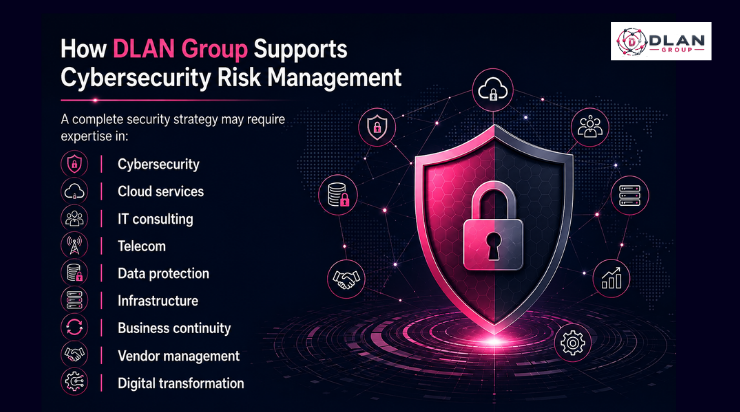
A complete security strategy may require expertise in:
- Cybersecurity
- Cloud services
- IT consulting
- Telecom
- Data protection
- Infrastructure
- Business continuity
- Vendor management
- Digital transformation
DLAN Group’s broader approach to modern business services supports organizations seeking more coordinated and resilient operations.
Conclusion: Turn Cybersecurity Risk Into a Manageable Business Priority
A cybersecurity risk assessment helps businesses move from uncertainty to informed action.
By identifying critical assets, relevant threats, technical vulnerabilities, business impacts, and existing controls, organizations can focus their security investment where it matters most.
The objective is not to eliminate every possible risk. It is to understand risk clearly, reduce serious exposure, assign responsibility, and build the ability to respond and recover.
Strengthen Your Cybersecurity With DLAN Group
Do not wait for a data breach, ransomware attack, account compromise, or system outage to expose weaknesses in your organization.
Contact DLAN Group to assess your current security position, identify priority risks, strengthen digital controls, and build a cybersecurity strategy aligned with your business operations.
Frequently Asked Questions
What is the purpose of a cybersecurity risk assessment?
Its purpose is to identify valuable digital assets, understand relevant threats and vulnerabilities, evaluate potential business impact, and prioritize appropriate security improvements.
How long does a cybersecurity risk assessment take?
The timeframe depends on the organization’s size, number of systems, locations, users, suppliers, and assessment scope. A focused review may take days or weeks, while a complete enterprise assessment can require several phases.
What is the difference between a vulnerability assessment and a risk assessment?
A vulnerability assessment identifies technical weaknesses. A risk assessment considers those weaknesses together with threats, likelihood, existing controls, and potential business impact.
Should small businesses conduct cybersecurity risk assessments?
Yes. Small businesses often depend heavily on a limited number of systems and employees. A serious incident may therefore cause significant operational and financial disruption.
What should happen after a cybersecurity risk assessment?
The organization should create a prioritized improvement plan, assign owners, define deadlines, allocate resources, track progress, and reassess risks regularly.


Leave a Reply
Want to join the discussion?Feel free to contribute!